
Solar Panels in Nova Scotia: A Homeowner's Guide
By Dan Carls, SolarQuotes.ca | Published November 20, 2026 | 12 min read

Quick answer
Rooftop solar can still make sense in Nova Scotia, even though the SolarHomes rebate is closed to new homeowner applications. If Nova Scotia Power is your utility, its Self-Generating Option lets you use extra solar power to offset later bills in the same calendar year, for systems up to 27 kW.
Start with a year of power bills and a quote that shows expected output for your roof. In Halifax, Solar City offers financing, not a rebate. If a town utility serves your home, check its rules instead.
Key points
- ●Nova Scotia Power's Self-Generating Option covers systems up to 27 kW. There is no separate program application, but permits and inspections still apply.
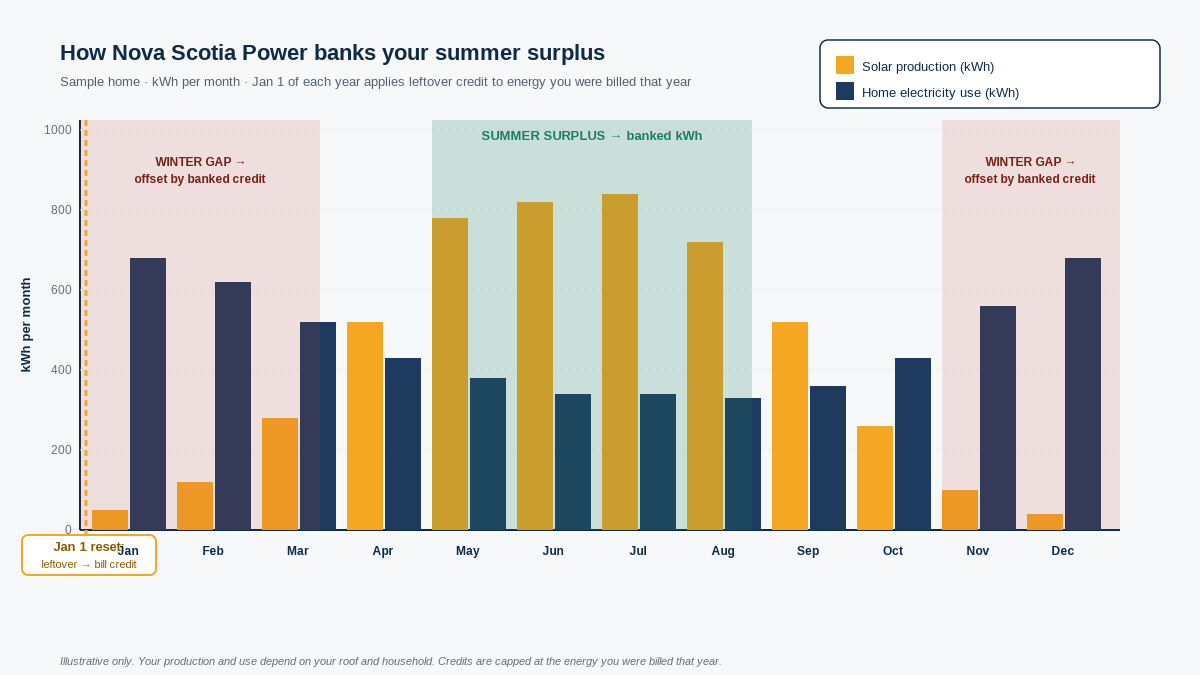
- ●Extra power you send to the grid offsets your later use. Each January 1, leftover credit becomes a dollar bill credit, capped at the energy you were billed that year.
- ●The standard home rate is 19.128 cents per kWh plus a $20.08 monthly base charge, since May 1, 2026. Solar does not remove the base charge.
- ●SolarHomes, the Home Battery Pilot and the federal Greener Homes Grant and Loan are all closed to new homeowners.
- ●Halifax Solar City offers a fixed 4.75% rate over 10 years for eligible properties.
First, check who your utility is
Most Nova Scotia homes buy power from Nova Scotia Power, and most of this guide follows its rules. But several towns run their own electric utility, such as the Antigonish Electric Utility. Their rates and solar rules can be different.
Look at the company name on your power bill. If it is not Nova Scotia Power, contact that utility before you get quotes and ask how it handles home solar.
How Nova Scotia Power credits your solar
Nova Scotia Power's program for home solar is called the Self-Generating Option. Here is how it works in plain terms.
Who qualifies
Your system can be renewable generation, energy storage or both, up to 27 kW total nameplate capacity, on the same meter as your home. If your design is close to that limit or includes a battery, ask your installer to confirm with the utility how the size is counted.
Month to month
Extra power is banked. When your panels make more than you use, the extra kWh are banked. They offset power you draw from the grid on later bills. When you use more than you make, you pay your regular rate for the difference.
At year end
January 1 is the reset date. On January 1 each year, any banked surplus is applied to energy you were billed earlier in that calendar year. It shows up as a bill credit on your first bill of the new year, worth what you paid for that energy. That dollar credit stays on your account until it is used.
Two limits matter here:
- The credit cannot be more than the energy you were billed that year.
- Nova Scotia Power does not buy power you make beyond your yearly use (NS Power).
So banked kWh do not roll over forever, and there is no payment for overproducing. This is why sizing your system to your actual yearly use matters so much in Nova Scotia.
What stays on your bill
You keep paying the monthly base charge no matter how much your panels make. If your meter cannot measure power flowing both ways, Nova Scotia Power replaces it at no cost.
Current Nova Scotia Power home rate
Energy charge: 19.128 cents per kWh | Base charge: $20.08 per month | In effect since: May 1, 2026
The 19.128 cent figure is the tariff's base energy rate of 18.324 cents plus the 2026 fuel rider (0.156 cents) and demand-side management rider (0.648 cents). Rates can change on January 1, 2027, so check the NS Power rate page before you rely on this number. See our Nova Scotia Power rates page for more detail.
For how Nova Scotia's rules compare with other provinces, see net metering in Canada explained.
Rebates and financing: what is open and what has closed
Several programs that older articles still mention are now closed to new homeowners. Here is where things stand as of November 2026.
| Program | Status for homeowners | What it means for you |
|---|---|---|
| SolarHomes (Efficiency Nova Scotia) | Closed | Stopped taking new homeowner applications on April 17, 2025. Do not let a quote subtract it. A separate path for non-profits and charities is handled differently. |
| Home Battery Pilot | Closed | No new enrollments. Budget for a battery at full price. |
| Canada Greener Homes Grant | Closed | Federal grant no longer available. |
| Canada Greener Homes Loan | Closed | Stopped taking applications after October 1, 2025. Remove it from any payment plan. |
| Clean Energy Financing (Clean Foundation) | Not accepting new applications | Check back with the program directly before planning around it. |
| Halifax Solar City | Open for registration | Financing, not a rebate. Fixed 4.75% over 10 years, repaid through a voluntary Local Improvement Charge on your property. Property must qualify, and you must sign an agreement before installation. |
Sources: Efficiency Nova Scotia, pilot terms, Government of Canada, Clean Energy Financing, Halifax Solar City.
If you live outside Halifax, ask your own municipality whether it runs a financing program, and confirm the terms with the town itself. For full program details, see our Nova Scotia solar rebates guide and Halifax Solar City program page.
What solar costs in Nova Scotia
The national benchmark. Canada's 2024 national survey put Nova Scotia home solar at $2.51 to $3.16 per watt. For a 7.5 kW system, that works out to roughly $18,800 to $23,700 (IEA PVPS Canada 2024, Table 13). That is 2024 data, not a 2026 price. Our Canadian solar cost guide explains how to use it.
One installer's real contracts. Xolar Energy reported 16 solar-only contracts signed in Nova Scotia in 2025. The median contract value was $42,895 and the median price it reported was $3.35 per watt, including HST and before incentives. A typical system was 12.3 kW (Xolar).
Disclosure: Xolar Energy is a fulfillment partner of SolarQuotes.ca. Its figures are one company's sample, not a provincial average. HST in Nova Scotia dropped from 15% to 14% on April 1, 2025, so tax-included contracts from 2025 are not all on the same tax basis.
For local budget estimates, see solar cost in Nova Scotia and solar cost in Halifax.
A simple payback example
This example shows how much the result depends on how your solar power is valued. It is not a typical quote or a promise.
Assumptions: a cash price of $24,000, 8,000 kWh made per year, and each kWh worth 19.128 cents when it offsets power you would have bought.
| Scenario | Yearly savings | Simple payback |
|---|---|---|
| All 8,000 kWh valued at the full rate | about $1,530 | 15.7 years |
| Only 70% valued at the full rate | about $1,071 | 22.4 years |
The gap between those two rows is the whole point. If your system makes more than you use in a year, the extra is not paid for, so part of your output earns nothing. A system sized to your real yearly use keeps more of its output valuable. For your own estimate, use your actual bills, Nova Scotia Power's rules and an output estimate for your specific roof.
From power bill to approval: the steps
- Check your utility and gather 12 months of usage. Your yearly kWh total sets the right system size.
- Get a roof and electrical assessment. The installer checks roof condition, shading, structure and your electrical panel.
- Compare designs and quotes. Ask for monthly output estimates and an itemized price. Find out if a structural review or municipal approval is needed.
- Sort out financing before work starts. Programs like Halifax Solar City need an agreement in place before installation.
- Permits and plans. Your contractor submits electrical plans, gets the wiring permit and books inspections. No separate application to Nova Scotia Power is needed, but these steps are not waived.
- Installation and final inspection. The system is installed and inspected.
- Meter and billing. Nova Scotia Power replaces your meter if needed and adjusts your account after the final inspection. Confirm how your credits will show on your bill.
Sources: NS Power installer guide, Halifax property owner guide, Halifax solar permitting FAQ.
Coastal wind, storms and outages
Build for the coast. Homes near the water face strong wind and salt air. Ask your installer to put these in writing:
- The wind load the racking is designed for
- The mounting system and how it attaches to your roof
- Corrosion coverage in the warranty
Halifax's solar contractor guide is a helpful checklist for these questions.
Solar is not backup by default. When Hurricane Fiona hit in September 2022, Nova Scotia Power reported about 415,000 customers without power (NS Power). A standard grid-tied solar system shuts off in an outage like that, for the safety of line crews. If backup power matters to you, ask for a separate backup design. Do not assume a sales quote for panels includes it.
Read solar battery backup for power outages and generator vs. solar battery backup to compare options. For winter output, see do solar panels work in Canadian winters.
Questions to ask a Nova Scotia installer
| Question | A good answer includes | Red flag |
|---|---|---|
| How did you size my system? | Based on my 12 months of usage | Sized to fill the roof |
| Which rebates did you include? | Only open programs I qualify for | SolarHomes or Greener Homes listed |
| What rate did you use for savings? | The current NS Power rate and year-end rules | A cents per kWh "export price" |
| What will it make each month? | A 12 month estimate for my roof | Only a yearly total |
| Is it built for coastal wind? | Wind load and corrosion terms in writing | Verbal assurances only |
| Will it work in an outage? | A clear no, or a separate backup design | "Yes" with no battery included |
| Who handles permits and inspection? | The contractor, with dates | Left to the homeowner |
Find local firms in our directory for Nova Scotia solar installers, including Halifax, Dartmouth and Bedford. No grid connection? See off-grid solar in Canada.
Compare Nova Scotia solar installers
Request an itemized quote with a monthly output estimate for your roof.
Request a Quotearrow_forwardWhen you request a quote, we share your details with a partner installer that serves your area, who will contact you to discuss your home. SolarQuotes.ca may be paid if you go ahead with a project. You are never required to buy.
Common questions
Is there still a solar rebate in Nova Scotia?
SolarHomes stopped taking new homeowner applications on April 17, 2025, and the federal Greener Homes Grant is closed. Halifax Solar City offers financing, which is not a rebate. Check our Nova Scotia rebates guide for any new programs.
Does Nova Scotia Power pay me for extra solar power?
Not in cash. Extra power offsets your later use in the same calendar year. On January 1, leftover credit becomes a bill credit, capped at the energy you were billed that year. Power beyond your yearly use is not purchased.
How big can my solar system be in Nova Scotia?
Up to 27 kW total nameplate capacity under Nova Scotia Power's Self-Generating Option. Most homes need far less. Size it to your yearly use.
Do I need to apply to Nova Scotia Power?
There is no separate program application or sign-up fee. Your installer still needs electrical plans, a wiring permit, inspections and any local approvals.
Will solar remove my power bill?
No. You still pay the $20.08 monthly base charge, and in darker months you may buy power beyond your banked credit.
Sources and how we wrote this
This guide was researched and written by the SolarQuotes.ca editorial team. We checked program rules and rates on official utility, government and municipal pages in November 2026. The payback figures are our own worked example. We will recheck the Nova Scotia Power rate after January 1, 2027.
- Nova Scotia Power: Self-Generating Option
- Nova Scotia Power: Standard residential service rate
- Nova Scotia Power: 2026 tariff book
- Efficiency Nova Scotia: SolarHomes
- Halifax: About Solar City
- Government of Canada: Canada Greener Homes Loan
- IEA PVPS: Canada 2024 national survey report
- Xolar Energy: Nova Scotia solar cost (partner data)
- Canada Revenue Agency: GST/HST rates
Related guides
Solar cost in Nova Scotia
Local budget estimates for Halifax, Dartmouth, Bedford and province-wide figures.
Nova Scotia solar rebates and financing
Current status of every NS solar program plus Halifax Solar City financing terms.
Nova Scotia solar installers
Vetted directory of installers across Halifax, Dartmouth, Bedford and the province.
How much do solar panels cost in Canada?
The national benchmark cost pillar — compare NS numbers against the Canada-wide range.
Dan Carls
Dan runs the SolarQuotes.ca editorial team. He writes plain-language guides for Canadian homeowners using public utility data, government research and installer quotes, and shows the source behind every key number.