
Generator vs. Solar Battery Backup: Which Fits Your Home?
By Dan Carls, SolarQuotes.ca | Published November 20, 2026 | 10 min read

Quick answer
A home battery suits short outages and a few key circuits, where quiet, automatic backup matters most. A fuel generator suits long outages and bigger loads, as long as you have a safe place for it and a steady fuel supply.
Solar panels help a battery recharge only if the system is built to do that and the panels are getting light. Start by listing what must stay on, how much power it needs to start and run, and the longest outage you want to plan for.
Key points
- ●The right choice depends on your loads and outage length, not on which product sounds better.
- ●A battery holds a fixed amount of energy. In our worked example, a 13.5 kWh battery lasts about 17 hours at a light 0.5 kW load, and under 6 hours at 1.5 kW.
- ●A standard grid-tied solar system shuts off in an outage. Backup needs the right equipment and setup.
- ●Fuel generators must run outdoors, at least 6 metres from any building. Connecting one to your home's wiring is a job for a qualified electrician.
- ●Some homes are best served by both: a battery for quiet, everyday outages and a generator for long ones.
Start with what has to stay on
Before you compare products, write down what you need during an outage. This one list decides almost everything else.
Common items for Canadian homes:
- Fridge and freezer
- A few lights
- Internet modem and phone charging
- Sump pump or well pump
- Furnace fan and thermostat controls
- Electric heat, if that is how you heat your home
For each item, note three things:
- Running power. How many watts it uses while on.
- Starting power. Motors in pumps, fridges and furnace fans need a short burst of extra power to start. Your backup system must handle that burst.
- Voltage. Some equipment, like many well pumps, runs on 240 volts. Not every backup setup supports it.
Electric heat is the item that changes the answer most. Baseboard heaters and electric furnaces draw a lot of power. A typical home battery is not built to run resistance heating for days. If your home relies on electric heat, plan for that load first.
The SolarQuotes.ca battery calculator can help you add up your essential loads.
Medical equipment
If anyone in your home depends on powered medical equipment, plan your backup with your doctor and the device supplier. Do not rely on a runtime example from a website, including this one (Government of Canada).
Four backup setups compared
| Option | Best reason to consider it | When it can be the wrong choice |
|---|---|---|
| Portable fuel generator | You only need a few things running, and someone at home can safely set it up and refuel it. | No safe outdoor spot, no one to run it, noise limits, or no proper way to connect it. Linking it to your home's electrical panel is professional work, not an extension cord job. |
| Automatic standby generator | Long outages and larger or motor-driven loads, with professional sizing and a reliable fuel supply. | Needs transfer equipment, a fuel hookup and regular maintenance. It runs only as long as fuel lasts, and it may not start every load at once. |
| Home battery, with or without solar | Quiet, automatic backup for a set list of circuits, with no fuel and no fumes. | Stored energy and power output are limited. Recharging from solar during an outage, cold weather limits and restarting after it runs empty all depend on the product and setup. |
| Battery, solar and standby generator | A professionally designed mix covers quiet overnight needs and keeps fuel backup for a long event. | Costs more and has more controls. Not every brand works together. Check the exact inverter, generator, switch gear and warranty terms. |
Sources: City of Toronto, BC Hydro, Government of Canada.
How long can a home battery run?
Battery runtime is simple math once you know two things: how much energy the battery can actually deliver, and how much power your home draws on average. Here is a worked example with no solar recharging at all. That is the safe place to start, because an outage can begin at night or during a snowstorm.
| Input | Value used | What it means |
|---|---|---|
| Usable capacity | 13.5 kWh | A common home battery size |
| Charge when outage starts | 90% | Batteries are not always full |
| Reserve floor | 20% | Energy held back and not used |
| Delivery efficiency | 90% | Some energy is lost converting it for your home |
Energy you can use: 13.5 kWh × (0.90 − 0.20) × 0.90 = about 8.5 kWh
At a light 0.5 kW average load: about 17 hours
At a heavier 1.5 kW average load: about 5.7 hours
To put that in context, a steady 0.5 kW load uses 36 kWh over three days, before any losses or reserve. That is more than four times what this battery can deliver from one charge.
These numbers do not prove that a given battery can start your well pump, that it has these exact limits or that it will be full when the power goes out. If your battery's usable rating already includes conversion losses, skip the 90% efficiency step. Use your own measured loads, not guesses.
Can solar recharge a battery during an outage?
Only if the system is designed for it. A regular grid-tied solar system shuts off when the grid goes down. This protects utility crews working on the lines (BC Hydro). To keep solar working in an outage, you need a battery and equipment that can safely separate your home from the grid.
Even then, it depends on light. In winter, short days and snow on the panels can mean little or no recharging for a day or more. Some systems also have rules about restarting after the battery runs completely empty. Ask your installer to show you, in writing, whether your battery can recharge and restart from solar while the grid is down, and have them test it when the system is commissioned.
Already have solar? See adding battery backup to existing solar. For how winter affects panel output, read do solar panels work in Canadian winters.
Generator safety comes first
Carbon monoxide can kill
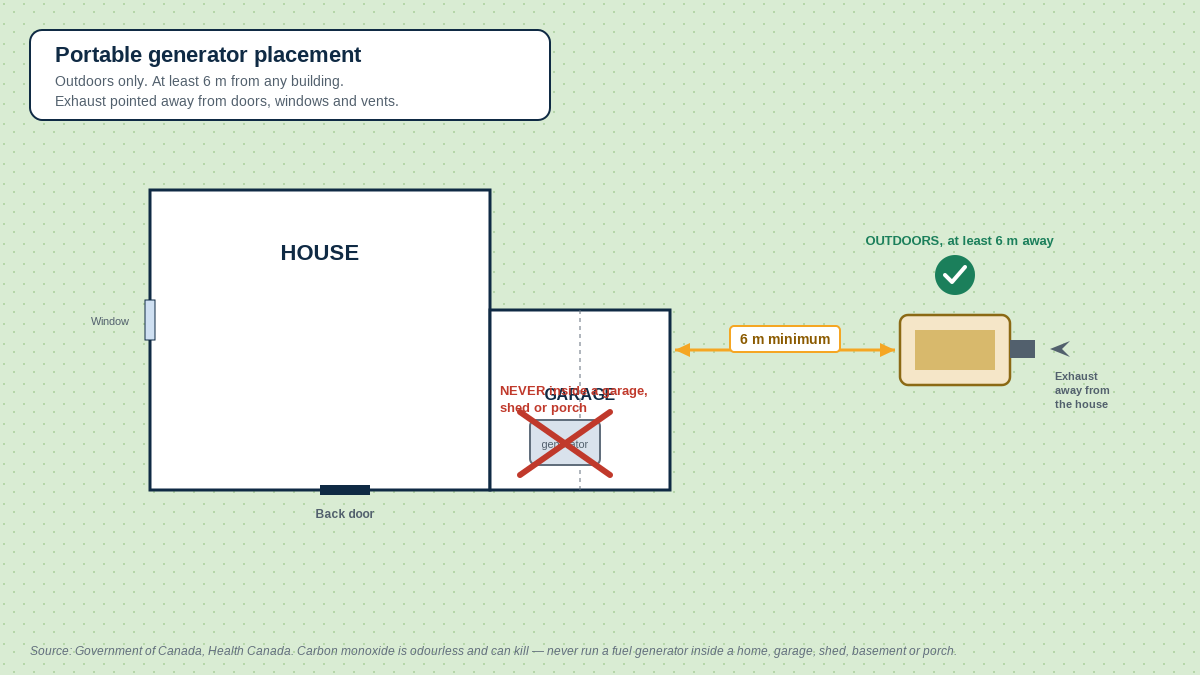
- Run a portable fuel generator outdoors only, at least 6 metres from your home or any building.
- Point the exhaust away from doors, windows and vents.
- Never run one in a garage, shed, basement or porch, even with the door open.
- Never plug a generator into a wall outlet to power your home. This can send power back into the lines and hurt you, your neighbours or utility workers.
- Connecting a generator to your home's wiring needs approved transfer equipment installed by a qualified electrician.
Sources: Government of Canada, Health Canada.
Install working carbon monoxide alarms on every level of your home, whichever backup option you choose.
How to compare installed costs fairly
The price of a portable generator in a store is not the cost of home backup. Neither is the sticker price of a battery. Ask for full installed quotes so you are comparing the same thing.
For a standby generator, ask for:
- The generator and its concrete pad or base
- Fuel hookup (natural gas or propane)
- Transfer switch and electrical work
- Permits and inspection
- Yearly maintenance cost
For a home battery, ask for:
- Usable storage in kWh and continuous power output in kW
- Inverter, gateway or backup loads panel
- Labour for your specific home, permits and any electrical upgrades
- A written list of which circuits will be backed up
- Commissioning tests, including a simulated outage
For battery prices and payback in Canada, see home battery backup cost and payback. To compare battery brands sold here, browse our home battery guides, including the Generac PWRcell, a brand that also makes standby generators. We name it as an example, not a product we tested.
Which one fits your home?
| If your situation is | Start by looking at | Watch out for |
|---|---|---|
| Short outages, a few key circuits, quiet matters | Home battery | Limited runtime and power for big loads |
| Long outages, well pump or electric heat | Standby generator | Fuel supply, maintenance and noise |
| Already have or want solar, outages are frequent | Solar plus battery | Winter recharging is not assured |
| Need quiet nights and protection for multi-day events | Battery plus standby generator | Cost and brand compatibility |
| Tight budget, occasional outages | Portable generator with a proper connection | Safe placement and someone to run it |
An honest note
SolarQuotes.ca connects homeowners with solar and battery installers. We do not sell generators. If a generator is the better fit for your home, a licensed electrician or a generator dealer is the right next call.
Questions to ask before you buy
- Which circuits will be backed up, and can the system start my largest motor load?
- Does it support the 240 volt equipment I need?
- How long will it run on my measured loads, with no solar and no refuelling?
- What are the cold weather limits for this exact model, and where will it be installed?
- Can the battery recharge and restart from solar while the grid is down?
- What fuel does the generator use, how much do I need to store and who services it?
- Who installs the transfer equipment, and are permits and inspection included?
Size battery backup for your essential loads
Add up what must stay on, then compare solar and battery quotes from local installers.
Common questions
Is a home battery better than a generator?
Neither is better in every case. A battery is quiet, automatic and fuel free, but it holds a limited amount of energy. A generator can run much longer and handle bigger loads, but it needs fuel, maintenance and a safe outdoor location.
Can a home battery run my whole house?
Usually not for long. Most setups back up a chosen list of circuits. Large loads like electric heat, ovens and dryers can drain a battery quickly or go past its power limit.
Will my solar panels work during a power outage?
Not if you have a standard grid-tied system. It shuts off for safety. Backup needs a battery and the right equipment. Our solar battery backup guide explains how that works.
Can I use a generator and a battery together?
Yes, with equipment designed to work together and a professional design. Not every battery, inverter and generator brand is compatible, so check the exact models and warranty terms. Off-grid homes often use this setup. See off-grid solar in Canada.
How far from my house should a portable generator be?
At least 6 metres from your home or any building, with the exhaust pointed away from doors, windows and vents.
Sources and how we wrote this
This guide was researched and written by the SolarQuotes.ca editorial team using Canadian government, utility and city guidance. The runtime figures are our own worked example using illustrative inputs. We did not test any generator or battery for this article.
Related guides
Solar battery backup for power outages
How grid-tied solar interacts with power outages, and what equipment you need for backup.
Add battery backup to existing solar
Retrofit paths for homeowners who already have panels and want outage protection.
Home battery backup cost and payback
What a Canadian home battery installation actually costs and when it pays back.
Grid-tied vs. off-grid solar in Canada
When off-grid makes sense and when grid-tied is the obvious pick.
Dan Carls
Dan runs the SolarQuotes.ca editorial team. He writes plain-language guides for Canadian homeowners using public utility data, government research and installer quotes, and shows the source behind every key number.